
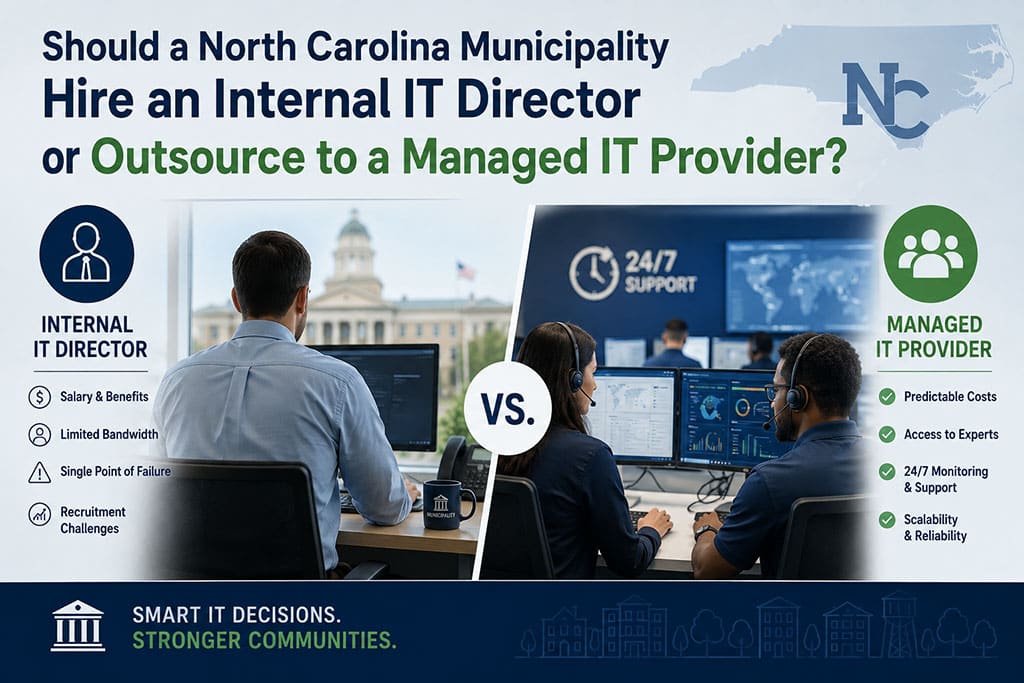
For municipalities across North Carolina, one of the biggest technology decisions isn’t which IT company to hire—it’s whether to build an internal IT department or partner with a Managed IT Services Provider (MSP).
For most municipalities with 20–200 employees, outsourcing IT or adopting a co-managed IT model provides broader technical expertise, stronger cybersecurity, and more predictable budgeting than relying on a single internal IT employee. While larger cities often require full internal IT departments, many towns find they receive better coverage, improved security, and greater value by partnering with an experienced municipal IT provider.
This guide compares the three most common IT models and helps municipal leaders determine which approach best fits their organization.
Quick Comparison
| IT Model | Best For | Pros | Considerations | |||
| Internal IT | Large municipalities with complex IT departments | On-site daily, institutional knowledge | Limited expertise, vacation coverage, higher staffing costs | |||
| Managed IT Provider | Most municipalities with 20–200 employees | Full team of specialists, predictable costs, 24/7 support | Requires selecting the right municipal IT partner | |||
| Co-Managed IT | Municipalities with an existing IT Manager | Combines internal leadership with outside expertise | Requires clear division of responsibilities | |||
| Category | Internal IT Employee | Managed IT Provider | ||||
| Staffing | One employee | Entire IT team | ||||
| Vacation Coverage | Limited | Included | ||||
| Cybersecurity Expertise | Depends on employee | Dedicated specialists | ||||
| Microsoft 365 Expertise | Varies | Included | ||||
| Strategic Planning | May require consultants | Often included through vCIO | ||||
| Emergency Support | Limited | 24/7 options available | ||||
| Budgeting | Salary + benefits + tools | Predictable monthly investment | ||||
Option 1: Hiring an Internal IT Employee
Many municipalities value having someone in the building who understands daily operations and can respond quickly to staff needs.
Advantages
An internal IT professional can provide:
- Immediate on-site support
- Strong relationships with department heads
- Familiarity with municipal operations
- Institutional knowledge
- Daily visibility into technology issues
For larger municipalities with multiple departments and complex technology environments, internal IT can be an excellent long-term investment.
Challenges
The biggest challenge is that one person cannot be an expert in everything.
Today’s municipal IT environments require expertise in:
- Cybersecurity
- Microsoft 365
- Networking
- Cloud services
- Backup and disaster recovery
- Compliance
- Vendor management
- Strategic planning
Recruiting and retaining experienced IT professionals is also becoming increasingly difficult.
An internal employee also requires:
- Salary
- Benefits
- Retirement contributions
- Continuing education
- Certifications
- Paid leave
- Backup coverage during vacations and emergencies
Option 2: Partnering with a Managed IT Provider
A Managed IT Services Provider gives municipalities access to an entire team of specialists for a predictable monthly investment.
Rather than relying on one individual, municipalities gain expertise across multiple technology disciplines.
Typical Services Include
- Unlimited help desk support
- Remote and on-site support
- Network monitoring
- Microsoft 365 administration
- Cybersecurity management
- Endpoint protection
- Backup monitoring
- Vendor management
- Strategic technology planning
- Virtual CIO (vCIO) services
- Technology documentation
- 24/7 monitoring and emergency response
This approach allows municipalities to scale their technology resources without adding additional full-time staff.
Option 3: Co-Managed IT
Many municipalities discover that the best solution isn’t choosing one model over the other.
Instead, they combine both.
A co-managed IT model allows an internal IT manager or technology coordinator to focus on leadership, projects, and departmental relationships while an MSP provides specialized expertise and additional support.
This model works particularly well when municipalities need:
- Additional cybersecurity expertise
- Microsoft 365 administration
- Vacation coverage
- After-hours support
- Project assistance
- Strategic planning
- Compliance guidance
Co-managed IT allows internal staff to focus on high-value initiatives while leveraging outside experts for specialized technical services.
Cost Comparison
While every municipality is different, the financial comparison often looks like this.
Beyond cost, municipalities should consider risk, resilience, and access to specialized expertise.
How Much Does Managed IT Cost for a North Carolina Municipality in 2026?
Which Model Is Right for Your Municipality?
Internal IT May Be Best If:
- You have several hundred employees.
- You operate a large internal IT department.
- You maintain specialized in-house applications.
- You require full-time on-site technical staff.
Managed IT May Be Best If:
- Your municipality has 20–200 employees.
- Technology responsibilities continue to grow.
- Cybersecurity is becoming a larger concern.
- You want predictable monthly budgeting.
- Recruiting IT talent has become difficult.
Co-Managed IT May Be Best If:
- You already employ an IT Manager.
- You need additional expertise.
- Your internal staff is stretched thin.
- You need stronger cybersecurity support.
- Large technology projects require additional resources.
Questions Every Municipality Should Ask
Before deciding between internal IT and outsourcing, ask:
- What happens if our IT employee resigns?
- Who handles cybersecurity?
- Who responds after hours?
- How are backups monitored?
- Who maintains documentation?
- How often is technology reviewed?
- Do we have a disaster recovery plan?
- Are we meeting CJIS security requirements?
- Can we support future growth?
- Are we spending strategically or simply reacting to problems?
The answers often make the right decision much clearer.
Municipal Success Story
One North Carolina municipality relied on a single technology employee responsible for everything—from password resets and workstation deployments to cybersecurity and strategic planning.
As technology demands increased, leadership adopted a co-managed IT model with CW IT Support.
The municipality retained its internal technology leadership while gaining access to cybersecurity specialists, Microsoft 365 experts, help desk technicians, strategic vCIO planning, backup management, and after-hours support.
The result was improved operational resilience, reduced dependency on a single individual, and a stronger overall technology program.
The Bottom Line
There isn’t a one-size-fits-all answer.
For many North Carolina municipalities, the decision isn’t choosing between internal IT or outsourced IT—it’s finding the right balance.
An experienced Managed IT Provider can supplement existing staff, strengthen cybersecurity, improve budgeting, and provide access to specialized expertise that would be difficult and expensive to build internally.
The best IT strategy is the one that supports your municipality’s mission, protects critical services, and prepares your organization for future growth.
Frequently Asked Questions
Is managed IT less expensive than hiring an internal IT employee?
In many cases, yes. While costs vary, managed IT services often provide access to an entire team of specialists for less than the total cost of hiring, training, and retaining multiple internal IT professionals.
Can a municipality have both an internal IT employee and a Managed IT Provider?
Absolutely. This is known as co-managed IT and is becoming increasingly popular among municipalities that want to strengthen cybersecurity and expand technical capabilities without replacing their internal staff.
At what size should a municipality hire a full-time IT employee?
There isn’t a universal threshold. Factors such as the number of departments, technology complexity, compliance requirements, and available budget all influence the decision. Many municipalities with 20–200 employees successfully partner with a Managed IT Provider instead of building a large internal IT department.
What are the biggest risks of relying on a single IT employee?
The most common risks include limited expertise, lack of vacation or emergency coverage, slower response during major incidents, and operational disruption if that employee leaves the organization.
Can a Managed IT Provider help with CJIS compliance?
Yes. An experienced municipal IT provider can assist with implementing security controls, managing Microsoft 365, securing endpoints, monitoring systems, maintaining documentation, and supporting municipalities as they work toward meeting CJIS Security Policy requirements.
What should municipalities look for when choosing a Managed IT Provider?
Look for a provider with municipal experience, cybersecurity expertise, responsive support, strategic planning capabilities, knowledge of compliance requirements, and a proven track record serving organizations similar to yours.
Why Municipalities Across North Carolina Choose CW IT Support
CW IT Support partners with municipalities across North Carolina to deliver secure, reliable, and strategic technology solutions.
Our team provides:
- Managed IT Services
- Co-Managed IT Support
- Municipal IT Expertise
- Cybersecurity Services
- CJIS Compliance Guidance
- Microsoft 365 Administration
- Strategic vCIO Planning
- 24/7 Help Desk and Emergency Support
- Local technicians serving communities across North Carolina
Whether you’re evaluating your current IT model or planning for the future, CW IT Support can help you determine the right strategy for your municipality.
Ready to discuss your municipality’s technology goals? Contact CW IT Support today to schedule a consultation with one of our municipal IT experts.